
When you file your federal income tax in the USA, there are many forms to know about. One important form is the tax return Form 1040-V. It helps you send payments to the IRS if you owe money. In this blog, we will cover all you need to know about tax return Form 1040-V and the available electronic payment options. IRS Form 1040-V is a payment slip. It helps the IRS apply your mailed payment to the correct tax account.
If you owe tax when filing IRS Form 1040, 1040-SR, or 1040-NR, and you pay by check or money order, use Form 1040-V. It acts like a payment slip that you send with your paper check. This form is not needed if you choose to pay online or use other electronic ways to pay.
What You’ll Learn From This Blog
By the end of this guide, you’ll understand:
- What is Tax Return Form 1040-V, and when is it required?
- How Tax Return Form 1040 and Form 1040-V work together.
- Who should use Form 1040-V, and who can skip it?
- How to complete Form 1040-V correctly when mailing a tax payment.
- The different IRS electronic payment options available instead of mailing a check.
- Common mistakes that can delay payment processing and how to avoid them.
- When should IRS Form 1040-ES be used instead of Form 1040-V?
- Best practices for ensuring your IRS payment is applied correctly.
What is the IRS Tax Return Form 1040?
Tax Return Form 1040 is the main form used by people to file income tax returns in the USA. The IRS uses this form to know:
• How much income did you earn?
• It also shows what deductions you can claim.
• The form helps identify which tax credits you qualify for.
• Additionally, it calculates how much tax you owe or if you are due a refund.
You can download tax return Form 1040 for free from the official IRS website.
Key Sections of Form 1040
Form 1040 is organized to capture essential financial information for accurate tax reporting. Understanding its structure is important for filing efficiently.
Personal Information
This section requires your name, Social Security number, and filing status (single, married filing jointly, married filing separately, head of household, or qualifying widow(er)).
Income
All sources of income must be reported here, including:
- Wages, salaries, and tips (from W-2 forms)
- Interest and dividend income
- Business income (Schedule C)
- Capital gains (Schedule D)
- Rental income
- Other miscellaneous income
Accurate reporting ensures correct tax liability and prevents IRS issues.
Adjustments to Income
Adjustments reduce your total income to arrive at your Adjusted Gross Income (AGI). Common adjustments include:
- Retirement plan contributions
- Student loan interest
- Health Savings Account contributions
- Self-employment tax deduction
Your AGI is crucial because it determines eligibility for many credits and deductions.
Deductions
Taxpayers can choose between:
- Standard Deduction: A fixed amount based on filing status
- Itemized Deductions: Includes mortgage interest, charitable contributions, medical expenses, and state and local taxes
Deducting the appropriate amount reduces taxable income and may lower your overall tax liability.
Tax Credits
Tax credits reduce your tax owed directly. Common credits include:
- Child Tax Credit
- Earned Income Tax Credit
- Education credits
- Energy-efficient home credits
Applying all eligible credits accurately is essential for minimizing your tax liability.
Taxes Paid and Refund or Amount Owed
After calculating your total tax liability and subtracting credits and taxes already paid through withholding or estimated payments, you can determine whether you:
- Are due a refund
- Owe additional tax
Form 1040 also provides space to indicate how you want your refund delivered, such as direct deposit.
Who Should File Form 1040?
The IRS says every U.S. citizen or resident must file if their income is above the set limit. This applies to people:
• Living in the U.S. or abroad
• With wages, business income, or passive income
• With foreign income (U.S. taxes on global income)
If you’re not sure whether you need to file, you should still check. Penalties may apply if you don’t file when you should.
What Are Forms 1040-EZ and 1040A?
Form 1040EZ
This is a short, simple version of tax return Form 1040. It was used before 2018 but is now no longer available. It was meant for:
• People who are single or married without kids
• Earn less than $100,000
• Have no claims like itemized deductions or credits
Form 1040A
This was also a shorter form than the 1040. It was for people who:
• Don’t own a business
• Earn less than $100,000
• Don’t itemize deductions
Now, all taxpayers use Form 1040, and extra schedules are added for complex income and claims.
Where and How to File Tax Return Form 1040?
There are two main ways to file your tax return Form 1040:
• Mail: You print and send it to the IRS. The address depends on where you live.
• E-File: You can file online using tax software or through a tax professional, and then make your payment through electronic payment options if you prefer.
E-filing is fast and gives you proof of submission. Refunds also come faster this way.
Schedules Attached to Form 1040
Depending on your financial situation, you may need additional schedules:
- Schedule 1: Additional income and adjustments
- Schedule 2: Additional taxes (such as AMT)
- Schedule 3: Nonrefundable credits
- Schedule C: Business income for self-employed taxpayers
- Schedule D: Capital gains and losses
- Schedule E: Rental and partnership income
Using the correct schedules ensures your 1040 income tax return is complete and accurate.
Can I Fix Errors After Filing Tax Return Form 1040?
Yes. If you find a mistake, you can file Form 1040-X to change:
• Filing status
• Income or deductions
• Tax credits
The IRS often fixes small math errors on its own, but if something major is wrong, you should file Form 1040-X. This helps correct your tax return and may reduce additional tax, penalties, or interest.
What is IRS Form 1040-V Used For?
Form 1040-V is used to send a payment by mail when:
• You owe tax after filing your return
• You are not paying online or through your bank
This form helps the IRS apply your payment to the correct account. It is a one-page slip that you send with your check or money order. If you don’t include Form 1040-V, the IRS might take longer to process your payment.
What Details Should I Include on Tax Return Form 1040-V?
To fill the 1040-V form, you will need:
• Your full name
• Social Security Number (SSN)
• Spouse’s SSN (if joint return)
• Street address
• The amount you are paying
Write your SSN and the tax year on your check or money order. Make it payable to:
“United States Treasury”
How Can I Pay For IRS Form 1040-V Online?
While IRS Form 1040-V is for mail payments, many people prefer using electronic IRS payment methods for faster and secure tax payments. Here’s how:
IRS Direct Pay
Use this free service to pay from a savings or checking account. You can schedule payment up to 30 days in advance.
Debit or Credit Card
The IRS allows card payments through third-party providers. They may charge:
• Flat fee for debit cards
• Percentage fee for credit cards
EFTPS (Electronic Federal Tax Payment System)
This system is great for people who pay taxes often or run a business.
Note: If you pay online, you do not need to send Form 1040-V.
How to Fill and Send IRS Form 1040-V?
Here’s a step-by-step guide to filling out and sending the form by mail:
Step 1: Prepare Your Tax Return
Complete the tax return Form 1040 and calculate the tax due.
Step 2: Fill Form 1040-V
Add your:
• Name
• SSN
• Address
• Payment amount
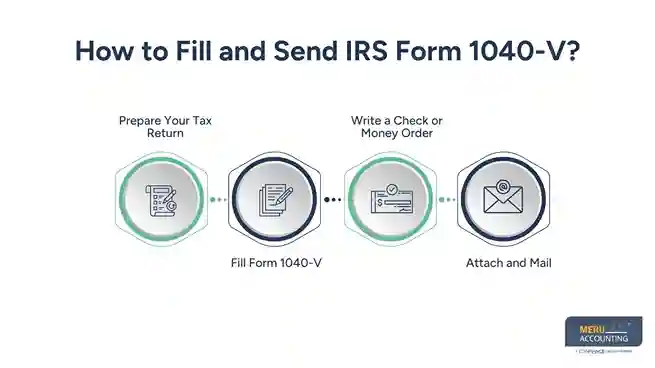
Step 3: Write a Check or Money Order
Make it payable to “United States Treasury.”
On your check, write:
• Your name
• SSN
• Tax year
• Form number (1040)
Step 4: Attach and Mail
Detach the payment slip from the bottom of the 1040-V form. Do not staple or paperclip it. Include your check and send both to the correct IRS mailing address.
Where to Mail IRS Form 1040-V?
Mailing addresses differ based on:
• The state you live in
• Whether you are including a payment
• Whether you’re using a private courier
You can check the IRS mailing address on the IRS instructions page.
Make sure:
• You use the right envelope
• You send it to the correct address
• You send it before the tax deadline
Where to Get Tax Return Form 1040-V?
You can get IRS Form 1040-V in the following ways:
• Download it from the IRS website
• Use tax filing software
• Pick it up from a local IRS office
It is often included when you use e-file software but choose to pay by mail.
Why IRS Form 1040-V Matters
Tax return Form 1040-V helps ensure that your check or money order is matched with your tax file. If not used properly, your payment may be delayed or misapplied.
Using it right means:
•Your payment is processed and applied correctly
• You avoid IRS notices
• Your record stays clean
Tips for Using Form 1040-V
Form 1040-V is a payment slip used when you pay federal taxes by check or money order. Using it the right way helps make sure your money is linked to your tax return without delay.
Follow these easy tips:
Double-Check the Amount
Before you pay, be sure the amount you enter on the form matches what you owe.
Even small errors can cause delays or lead to a letter from the IRS. Use your tax return to find the right number.
Match Your Name and SSN
The IRS uses your name and Social Security Number (SSN) to link your payment to your file.
Write both exactly as they appear on your tax return. Spelling or number errors can slow things down.
Write the Check the Right Way
Make the check or money order payable to:
“United States Treasury”
• Do not use short names or spelling errors
• On the memo line, write:
• Your SSN
• The tax year (like “2024”)
Use the Correct Mailing Address
IRS payment addresses are not the same for all states.
They also change if you send a payment with or without your full tax return.
To avoid delays:
• Check the latest IRS mailing list online
• Or read the back of Form 1040-V for your correct address
Keep a Copy for Your Records
Once you send your form and check:
• Take a photo or scan of the filled Form 1040-V
• Make a copy of your check or money order
This gives you proof in case:
• The IRS says they didn’t get it
• You need to fix a problem later
Common Mistakes to Avoid
Many people make simple mistakes when sending payments with Form 1040-V. Avoid these to make sure your payment gets processed fast and right:
- Not Including Form 1040-V
If you send a check without the slip, the IRS might not match it to your tax file. This can cause delays or errors. Always send Form 1040-V with your check. - Wrong Payment Amount
Make sure the amount is right. If you pay less, the IRS may charge late fees or interest. If you pay more, you may wait a long time for a refund. - Unsigned check: An unsigned check or form can be rejected. Sign your check and fill out all needed parts on Form 1040-V.
- Wrong mailing address: The IRS has many addresses for payments. Sending it to the wrong one can slow or lose your payment. Check the right address before you mail.
- Late mailing: Mail your payment early so it is postmarked by the tax deadline.
How the IRS Processes Tax Return Form 1040-V
When the IRS gets your tax return Form 1040-V and payment, they use the form to match the amount with your tax file. This helps stop delays or errors. Here’s how it works, step-by-step:
Receipt – The IRS gets your mail at the correct tax office.
Check – The IRS uses the information on Form 1040-V to apply your payment to the correct tax account.
Apply Payment – Your money is added to your tax file. The payment is applied toward your tax liability.
Confirm – You can track the payment online. Processing times vary depending on mailing time and IRS workload.
Can You Use IRS Form 1040-V for Estimated Tax Payments?
No. Form 1040-V is only for payments sent with your yearly tax return.
It is not for estimated tax payments made during the year.
To pay estimated tax, you must use Form 1040-ES.
It has four payment slips—one for each quarter. These slips help the IRS know which time your payment covers.
If you send an estimated tax payment without the right slip:
• The IRS may not apply the payment correctly.
• It can lead to errors or delays.
What Happens If You Don’t Use Tax Return Form 1040-V?
If you send a payment without tax return Form 1040-V:
• The IRS may take longer to match your payment
• You may get IRS letters asking for proof or more details
• You might face penalties or interest if your payment is not posted on time
• Your payment may be delayed or you may receive an IRS notice if the payment cannot be matched correctly.
Using Form 1040-V helps stop these issues by giving the IRS the info needed to link your payment.
How to Pay Without Using Tax Return Form 1040-V
Mailing a payment with Form 1040-V is the usual way, but you can pay your taxes other ways too:
• Online payment
• EFTPS
• Phone payments
• Credit or debit card
If you mail a check, do not skip Form 1040-V. Leaving it out can slow down how the IRS applies your payment.
Handling taxes can be tough. Whether you’re mailing or using electronic IRS payment methods, expert help can ensure accuracy. At Meru Accounting, we help you:
• Prepare Form 1040 and all schedules
• Calculate taxes due
• Pay online or by check
• Use Form 1040-V the right way
Our Expert Insight
Many taxpayers assume that Tax Return Form 1040-V is another tax return form, but it is simply a payment voucher used when mailing a check or money order with your federal income tax return. If you pay electronically through an IRS-approved payment method, you generally do not need Form 1040-V. Understanding when this form is required—and when it is not—can help you avoid processing delays, unnecessary IRS notices, and payment application issues. Before mailing your payment, always verify the latest IRS instructions and mailing address for your state to ensure your payment reaches the correct processing center.
Key Takeaways
- Tax Return Form 1040-V is a payment voucher used only when mailing a federal tax payment by check or money order to the IRS.
- If you pay your taxes electronically using IRS Direct Pay, EFTPS, or an approved debit or credit card service, you do not need Form 1040-V.
- Tax Return Form 1040 is the primary federal income tax return, while Form 1040-V is only used to help the IRS apply a mailed payment to the correct tax account.
- Always include accurate information on Form 1040-V and mail it to the correct IRS address to help avoid payment processing delays.
- Form 1040-V should not be used for estimated tax payments. Instead, use Form 1040-ES or another IRS-approved payment method for estimated taxes.