How the Direct Write Off Method Helps Your Business Stay on Track
Running a business means tracking all the money that comes in and goes out. When a customer doesn’t pay what they owe, the Direct Write Off Method helps you handle the loss properly. It helps you manage bad debts effectively. In this blog, we’ll explain what the method is, how it works, and whether it’s right for your business.
What is the Direct Write Off Method?
The Direct Write-Off Method is a method for handling unpaid bills in business records. When a customer doesn’t pay, that money becomes bad debt. With this method, you write it off only when you’re sure you won’t get paid.
This means you don’t guess how much debt you might lose in advance. Instead, you wait until you know for sure that someone isn’t going to pay. Then you remove it from your records as income. It’s a simple method that works best for small businesses or those with low credit risk.
How the Straight Write-Off Method Works in Accounting
The process is easy to follow. Let’s say your business gave goods worth $1,000 to a customer on credit. If that customer never pays, you will write off the $1,000.
1. Invoice Goes Unpaid
You send an invoice after a credit sale. The customer does not make the payment even after several reminders, or the due date passes.
2. Waiting Period Begins
You wait for a reasonable time, trying to collect the amount. This can vary depending on your terms or industry.
3. Decision to Write Off
You decide that the debt will not be collected. The customer might have closed the business or cannot be reached.
4. Entry in the Books
You record the amount as bad debt. It lowers your income and removes that customer from accounts receivable.
5. Tax Impact
You may also use this entry when filing taxes. It reflects your actual earnings more truthfully for that year.
6. Updated Financials
Your income and balance sheets now show the correct figures. This helps keep your business books honest and simple.
When to Use the Direct Write Off Method
The Direct Write Off Method may not suit every business, yet it’s useful in many cases.
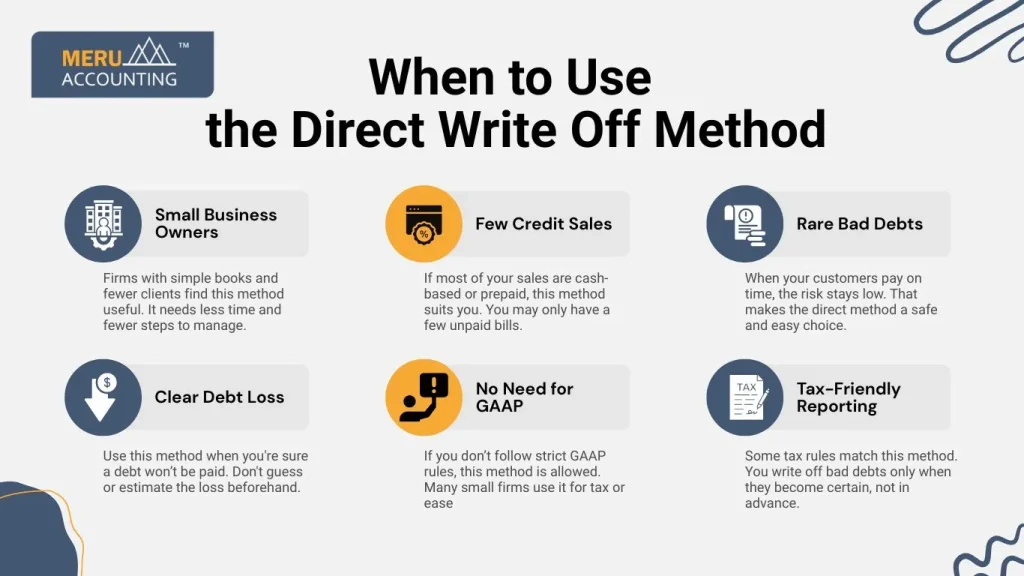
1. Small Business Owners
Firms with simple books and fewer clients find this method useful. It needs less time and fewer steps to manage.
2. Few Credit Sales
If most of your sales are cash-based or prepaid, this method suits you. You may only have a few unpaid bills.
3. Rare Bad Debts
When your customers pay on time, the risk stays low. That makes the direct method a safe and easy choice.
4. Clear Debt Loss
Use this method when you’re sure a debt won’t be paid. Don’t guess or estimate the loss beforehand.
5. No Need for GAAP
If you don’t follow strict GAAP rules, this method is allowed. Many small firms use it for tax or ease.
6. Tax-Friendly Reporting
Some tax rules match this method. You write off bad debts only when they become certain, not in advance.
Key Differences Between Direct Write Off Method and Allowance Method
Feature | Direct Write Off Method | Allowance Method |
Timing of Write-Off | After the debt is proven to be unpaid | Before it is confirmed (based on the estimate) |
Simplicity | Very simple and easy to apply | More complex, needs forecasts |
GAAP Compliance | Not GAAP-compliant | GAAP-approved method |
Accuracy of Reports | Can mismatch income and expense timing | Matches revenue with expected costs |
Best For | Small firms with rare bad debts | Larger firms or those with frequent bad debts |
Financial Statement Impact | May show higher profit before the write-off | Spreads losses across sales periods |
Estimate Use | No estimates used | Uses past data to predict losses |
Advantages and Disadvantages of the Bad Debt Write-Off Method
Advantages of the Bad Debt Write-Off Method
Easy to Understand
- No hard formulas or guesses are needed.
- You record a write-off only when it’s clear the debt won’t be paid.
Simple to Record
- One journal entry covers the whole bad debt.
- This keeps your books neat and cuts errors.
Good for Small Firms
- Small businesses with few records gain the most.
- The method saves time and suits their needs.
Disadvantages of the Bad Debt Write-Off Method
Not GAAP-Friendly
- Large firms following GAAP cannot use this method.
- This is a key legal and compliance limit.
Delayed Expense Recording
- Expenses show only after the debt is uncollectible, often months later.
- This can make profit reports seem off.
No Forecast of Risk
- This method does not show potential losses early.
- Books may temporarily show more profit than earned.
Steps to Implement the Direct Write Off Method
The Direct Write Off Method is easy to use. Follow these steps:
- Identify bad debts often.
- Check that the debt cannot be paid.
- Record the debt as an expense in your accounts.
- Update accounts receivable to show the loss.
- Keep records for tax and audit purposes.
Using the Direct Write Off Method consistently helps keep your books correct and up to date.
Impact of Bad Debt Write-Offs on Your Business Reports
This method has clear effects on your main financial reports. Let’s see how.
1. Income Statement Shows Loss
When you write off the debt, it appears as a cost. This reduces your net profit in that period.
2. Receivables Drop
Your balance sheet will show less money owed to you. This gives a more realistic view of what’s due.
3. Accurate Tax Reporting
By writing off confirmed bad debts, your tax returns match your true income more closely.
4. No Change in Cash Flow
You’re not handling real money in this entry. So your cash position doesn’t change, only the records do.
5. Better Year-End Clarity
At the end of the year, your records show actual income. You know what was truly earned.
6. Easier Audit Trails
Auditors or owners can trace the reason for each bad debt. That adds trust and makes reviews easier.
Common Mistakes Businesses Make Using the Bad Debt Write-Off Method
Even though this method is simple, some businesses make mistakes. Here are the most common ones to avoid.
1. Delay in Writing Off
Don’t wait too long. Long delays cause your profits to appear better than they are.
2. Writing Off Too Soon
Avoid writing off before you’re certain. The customer might still pay, and that would hurt your numbers.
3. No Backup Documents
Always keep proof like emails or call logs. You need support for the write-off, especially for taxes.
4. Forgetting to Update Ledgers
Failing to remove the entry from receivables creates errors in tracking what’s owed to you.
5. Applying to All Clients
Not all customers are the same. Don’t treat risky and safe clients the same way for write-offs.
6. Ignoring Cash Flow Reality
This method affects your reports but not your bank. Know the difference so you don’t get confused.
Real-Life Example of Direct Write Off Method
Here’s a simple example:
- A customer owes $500.
- The customer cannot pay after multiple reminders.
- Using the Direct Write Off Method, the business writes off $500 as a bad debt.
- Accounts receivable decreases by $500, and the loss is recorded.
This shows the method’s simplicity and effectiveness.
Is the Write-Off Approach Right for Your Business?
You can use these checks to see if the Direct Write Off Method is right for your business.
1. Few Credit Clients
If most of your sales are upfront, the method will work fine. You won’t have many debts to chase.
2. Rare Write-Offs Needed
Low customer risk means this method makes sense. You won’t often need to use it.
3. Want Simpler Books
You prefer to keep books easy and clear, with fewer entries and no forecasts to manage.
4. Not Following GAAP
If you don’t need to follow GAAP, this method can save time and reduce effort in accounting.
5. Need Real-Time Records
You want your reports to reflect what happens in real time, rather than estimates.
6. Planning to Grow
If you’re small now but growing fast, start with this method and switch later when complexity rises.
At Meru Accounting, we help you handle bad debts with skill. We know small and mid-size businesses need clear and quick record-keeping. We help you track unpaid invoices and confirm when it’s time to write them off safely. Our team records write-offs correctly, so your income and receivables match your real books.
FAQs
- What is the Direct Write Off Method?
It’s a way to remove unpaid customer balances from your books. You write off the amount only when you are sure the customer won’t make the payment.
- Who should use this method?
This method suits small businesses with few credit clients and rare bad debts. It helps keep bookkeeping simple without needing to guess future losses.
- Is this method allowed under GAAP?
No, this method does not follow GAAP rules. Companies that must comply with GAAP should use the Allowance Method for reporting doubtful accounts.
- How does it affect my taxes?
If you use the cash or modified accrual basis, this method may reduce your taxable income when bad debts are confirmed and written off.
- Can I switch methods as my business grows?
Yes, you can start with this simple method and later shift to another one, like the Allowance Method, as your accounting needs become more complex.
- Will it change my cash flow?
No, your cash flow stays the same. Writing off bad debts is just a record change and does not involve any actual cash transactions.