

When the tax return filing date is around the corner, business owners always experience complications. Figuring out the deductions, calculating the taxes, reclaiming, etc., are some of the tedious tasks for US-based individuals and businesses. However, navigating and filling out the complicated forms is a difficult task for business owners, tax consultants, and accountants. If you are operating a business in the USA, then Form 8995 becomes very important. This form is to figure out the deductions for the Qualified Business Income (QBI).
The 8995 is the simplified IRS form used to calculate the Qualified Business Income (QBI) deduction. While it is easier than Form 8995-A, taxpayers must still complete it carefully to ensure they claim the correct deduction. In this blog, we have tried to give you complete guidance on this federal tax form.
What You Will Learn From This Blog
By reading this guide, you will learn:
- What the simplified IRS form is and how it helps eligible taxpayers claim the Qualified Business Income (QBI) deduction.
- Who qualifies for the QBI deduction, and when the detailed Form 8995-A is required instead?
- What counts as Qualified Business Income (QBI), and which types of income are excluded?
- How to complete the form correctly, understand each section, and calculate your eligible deduction.
- The differences between the simplified form and Form 8995-A.
- Common filing mistakes, practical tax tips, and best practices to help maximize your deduction while staying compliant with IRS requirements.
What is Federal Tax Form 8995?
- Federal Tax Form 8995 is used to calculate the Qualified Business Income (QBI) deduction.
- It helps eligible taxpayers calculate and claim the Qualified Business Income (QBI) deduction, which can be up to 20% of qualified business income, subject to IRS rules and limitations.
- It’s a simplified form and is used by many small business owners, freelancers, and sole proprietors.
- The QBI deduction was created under the Tax Cuts and Jobs Act (TCJA) and first became available beginning with tax year 2018.
- It’s mainly for individuals with simpler tax situations and without phase-out limits.
Sections of Form 8995
Here’s what you’ll find in Form 8995:
- Part I: Business Details: List your business name and EIN (if you have one), and report how much qualified income you earned.
- Part II: Calculating QBI: Combine the QBI from all your qualified businesses. Make sure each one meets the rules and make adjustments if needed.
- Part III: Determining the Deduction: Multiply your total QBI by 20%. This gives you the QBI deduction amount.
- Part IV: Reporting the Deduction: Report the final number on your Form 1040, your main individual tax return.
What is the Purpose of the 8995 IRS Form?
The qualified business income deductions allow businesses to deduct up to 20% of their qualified business income. This income may come from business, trade, pass-through firms (not C corps), REITs, and income from listed public partnerships. The 8995 helps eligible taxpayers calculate their Qualified Business Income (QBI) deduction. In general, the deduction is limited to the lesser of:
- 20% of qualified business income (plus any qualified REIT dividends and qualified publicly traded partnership income, where applicable), or
- 20% of taxable income minus net capital gain.
Who Can Use IRS Form 8995?
You can use it if:
- You have income from a qualified trade or business.
- Your taxable income is below the IRS threshold:
- For 2024: $182,100 (Single) or $364,200 (Married filing jointly).
- You are not in a Specified Service Trade or Business (SSTB) over the income limit.
- You do not have to use Form 8995-A, which is more detailed.
What are the Eligibility Criteria to Claim the Deductions?
The IRS Form 8995 can be filled out by entities to claim deductions that fulfill the below-mentioned eligibility criteria:
- Get qualified business income
- Be a pass-through business entity
- Meet the IRS taxable income requirements for using Form 8995
How do I fill out Form 8995 in a Simplified Way?
Taxpayers who have QBI, qualified REIT dividends, or qualified PTP income must use this form to calculate their deductions. There are two versions of the form: Form 8995, Qualified Business Income Deduction – Simple Math, and Form 8995-A, Qualified Business Income Deduction – Full Version.
Eligible taxpayers use the form, while taxpayers with higher taxable income or more complex situations generally use the 8995-A form. Form 8995 is designed for eligible taxpayers with relatively straightforward tax situations. Taxpayers subject to wage, qualified property, or Specified Service Trade or Business (SSTB) limitations generally use Form 8995-A. The regular computation method may be required for taxpayers with more complex situations. There are limitations and phaseouts based on taxable income, type of business, and other factors that may affect the amount of the deduction that a taxpayer can claim.
What is Qualified Business Income (QBI)?
QBI is the net amount of income, gains, deductions, and losses from a qualified business.
Examples include:
- Self-employed business income
- Rental income (in some cases)
- Income from LLCs, partnerships, or S corporations
QBI does not include:
- Reasonable compensation received by S corporation shareholders.
- Guaranteed payments received by partners.
- Capital gains and capital losses.
- Dividend income.
- Most interest income is not related to the business.
- Wage income reported on Form W-2.
- Certain foreign currency gains and commodity transactions are not connected to the business.
Note: Qualified REIT dividends and qualified publicly traded partnership (PTP) income are not included in QBI itself, but they may qualify for a separate deduction under Section 199A.
How do I determine the QBI?
QBI would include deductions, gains, losses, etc., from the business that conducts the trade or business. You must consider the attributes while filling out the federal tax Form 8995. Some aspects are not included in the QBI.
Some of the aspects that are not included under QBI are mentioned below:
- When an S Corporation receives a reasonable compensation amount,
- Internal Revenue Code (Code) provisions provide for capital losses or gains.
- Improperly allocated income interest for the business.
- Losses, income, or deductions that we get from principal contracts.
- Real estate investors trust dividends.
- Publicly traded partnership income.
Example
- You are a sole proprietor.
- Your QBI from business is $80,000.
- Your taxable income is $100,000.
- You qualify to use the 8995 Form.
Calculation:
- 20% of $80,000 = $16,000.
- You can deduct $16,000 from your taxable income using Form 8995.
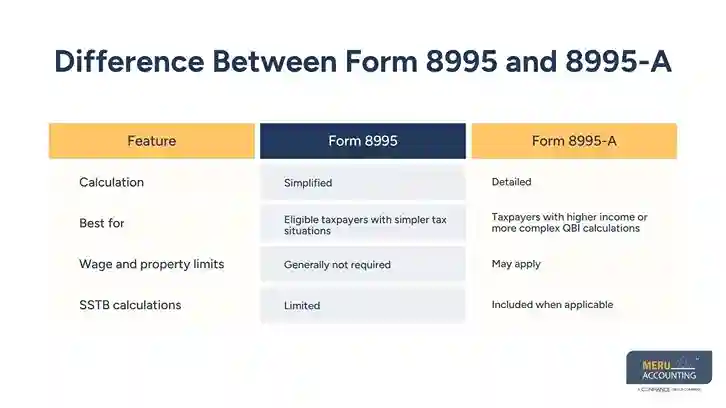
Difference Between Form 8995 and 8995-A
Feature | Form 8995 | Form 8995-A |
Calculation | Simplified | Detailed |
Best for | Eligible taxpayers with simpler tax situations | Taxpayers with higher income or more complex QBI calculations |
Wage and property limits | Generally not required | May apply |
SSTB calculations | Limited | Included when applicable |
Tips for Filing the 8995 Form
Keep clear records
Track all income, expenses, and past losses. Good records help avoid errors and prove your claim if the IRS asks.
Use tax software
Most software tools guide you through the IRS Form 8995 and check for common mistakes. This makes filing easier and safer.
Consult a tax expert for complex cases
If you have more than one business or past-year losses, ask a tax pro. They can help with tricky rules and reduce audit risks.
Double-check your QBI
Make sure your income qualifies. W-2 wages, interest, capital gains, and dividends should not be included in QBI.
Know the income limits
The QBI deduction is reduced or removed if your total income is too high, especially for service-based jobs like health, law, or finance.
Attach supporting documents if needed
You may need to show proof of income, losses, or business type. Keep all tax files and records ready.
Don’t rush the filing
Review your return before you file. Double-check names, numbers, and forms to avoid mistakes and delays.
Common Mistakes to Avoid
Using the wrong form
If your income goes over the IRS limit for the Qualified Business Income (QBI) deduction, use Federal Tax Form 8995-A instead of Tax Form 8995. Many people file the short form (Form 8995) by mistake. This may delay the processing of your return or require you to file corrections.
Including W-2 wages as QBI
W-2 wages do not count as Qualified Business Income. Only income from businesses like sole proprietorships, S corporations, and partnerships is allowed. Adding W-2 wages by mistake can cause big tax errors.
Not subtracting past year losses
If your business had losses in the past, you must subtract them from your QBI this year. Skipping this step may lead to claiming a bigger deduction than allowed and could trigger an audit.
Misclassifying business income
Make sure the income you list meets QBI rules. Most investment income, such as dividends, capital gains, and interest, does not qualify as QBI. Rental income may qualify only if it meets IRS requirements for a trade or business. Listing these as QBI may lead to issues with the IRS.
Ignoring SSTB limits
Some trades, like law, health, or finance, face QBI limits if income is too high. These are called Specified Service Trades or Businesses (SSTBs). Not checking this rule may lead to claiming more than you can.
Poor recordkeeping
You must keep clear records of income, expenses, and past-year losses. Without these, you can’t support your QBI claim if the IRS asks for proof.
These are some of the basic guidelines about IRS Form 8995 that must be considered by the respective entities in the USA. It might be very complicated for business owners and accountants to fill out this form properly.
It is advisable to get consultation from proper experts while filling out the form. Meru Accounting helps eligible individuals and businesses prepare IRS Form 8995 accurately and in accordance with current IRS guidelines. We are one of the most proficient tax consulting service providers in the USA. Our team has all the knowledge about filling out this form as per IRS guidelines.
Our Expert Insight
The Qualified Business Income (QBI) deduction offers eligible business owners an opportunity to reduce taxable income by up to 20%, but claiming it correctly requires more than simple calculations. Many taxpayers make mistakes by including non-qualifying income, overlooking prior-year losses, or selecting the wrong filing method. Understanding the eligibility rules, maintaining accurate financial records, and reviewing taxable income before filing can help maximize the deduction while reducing the risk of IRS notices or processing delays.
Key Takeaways
- The simplified IRS form helps eligible taxpayers calculate and claim the Qualified Business Income (QBI) deduction.
- Eligible business owners may deduct up to 20% of qualified business income, subject to IRS rules and taxable income limitations.
- Taxpayers with straightforward tax situations generally use the simplified form, while more complex cases may require Form 8995-A.
- Qualified Business Income includes eligible earnings from pass-through businesses but excludes W-2 wages, capital gains, dividends, and most interest income.
- Careful recordkeeping, accurate QBI calculations, and choosing the correct filing method can help you claim the deduction correctly and avoid common filing errors.